Professional Ant Control in Mt. Pleasant & the Lowcountry
Ant pest control in Mt. Pleasant is a year-round job, not a summer one. The Lowcountry’s humid coastal climate, sandy soil, and mild winters give ant colonies almost no downtime — and older homes in neighborhoods like Old Village, I’On, Park West, Belle Hall, and Dunes West tend to have the crawl spaces, moisture, and landscaping ants love most.
That’s why a national-chain exterminator often misses what we catch on the first visit. We treat ants the way they actually behave in coastal South Carolina — not the way a generic playbook says they should.
Learn more about our whole-home pest control and crawl space encapsulation services.
Why Mt. Pleasant Homeowners Choose Us
- Family-Owned & Locally Operated
- 22+ Years of Local Experience
- Same-Day & Next-Day Service
- Honest, Flat-Rate Estimates
- Free On-Site Inspections
- $25 Off Your First Treatment
- 10% Military Discount
- Licensed, Certified & Fully Insured
Common Ants We Treat in Mt. Pleasant & the Lowcountry
Correct identification is half the job. Different ant species need different treatments — a bait that wipes out a carpenter ant colony will actually make a pharaoh ant problem worse. Here are the species we see most often on Mt. Pleasant properties.
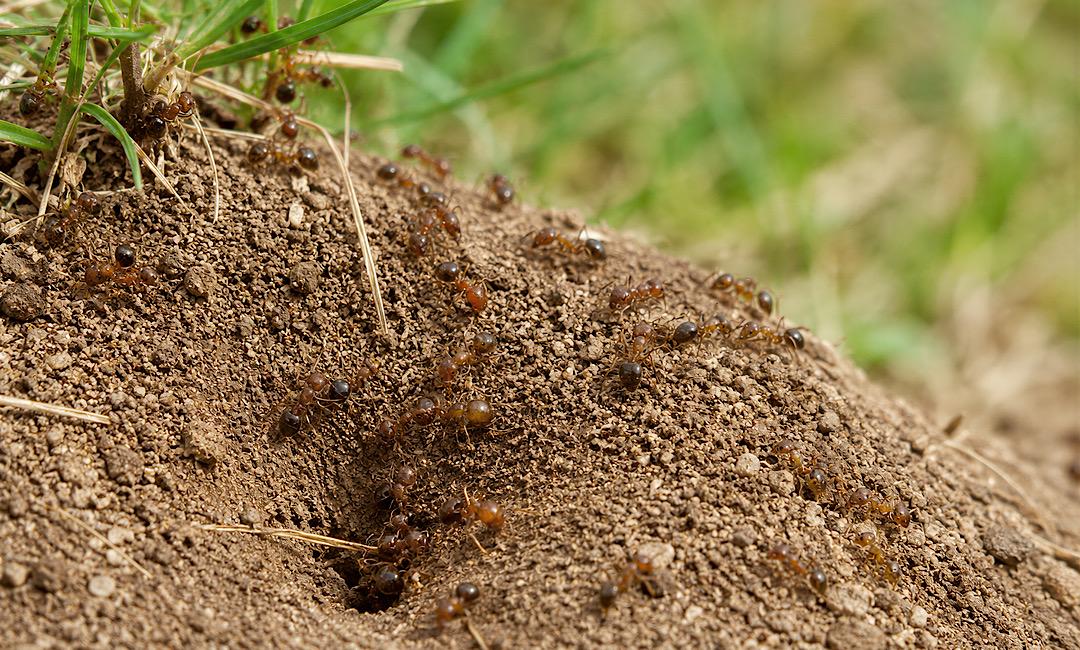
- Red Imported Fire Ants. Large dirt mounds in lawns, painful stings, and aggressive swarming when disturbed. All of Charleston County sits inside the USDA federal fire ant quarantine zone, which means every property here is at risk. We use a two-step approach — direct mound treatment plus a broadcast bait — that actually collapses the colony instead of just scattering it.
- Carpenter Ants. The second-most-destructive wood pest in the Lowcountry after termites. They don’t eat wood, but they hollow it out to nest — usually in moisture-damaged framing, deck posts, window sills, and tree stumps. Finding them is often a sign of a bigger moisture problem. See our termite control services if you’re worried about wood damage.
- Argentine Ants. Tiny, brown, and relentless. They form supercolonies with multiple queens, so the standard retail spray just splits them into more colonies. We use non-repellent residuals and targeted baits to take out the whole network.
- Odorous House Ants. Small, dark, and unmistakable — they smell like rotten coconut when you crush one. They love moisture and sweets, which is why they end up in kitchens, bathrooms, and around leaky pipes.
- Asian Needle Ants. An invasive species that’s established across South Carolina and medically significant — stings can cause severe allergic reactions, including anaphylaxis in sensitive people. Most of our neighbors don’t even know this ant is on their property. We do.
- Acrobat Ants. Named for how they raise their abdomen when disturbed. They nest in wall voids, foam insulation, and moisture-damaged wood — often alongside carpenter ant or termite activity, which makes them an early-warning pest worth taking seriously.
- Ghost Ants, Pharaoh Ants & Little Black Ants. The indoor-nuisance trio. Small, persistent, and drawn to sweets, grease, or standing water. Pharaoh ants in particular will “bud” (split into multiple new colonies) if you treat them with the wrong spray, which is why DIY often makes them worse. We use colony-wide baits that eliminate them at the source.
For identification photos and more detail on each species, visit our Pest Library.
Our 4-Step Ant Control Process
- Free on-site inspection. We walk the property, identify the species, and locate nesting sites, foraging trails, and entry points. No guesswork, no flat-rate upsells.
- Targeted, species-specific treatment. We combine colony-eliminating baits with non-repellent residuals at entry points. One treatment is never the same as another — pharaoh ants, fire ants, and carpenter ants each get a different plan.
- Exterior perimeter plus interior hot spots. Foundation, soffits, window frames, plumbing penetrations, kitchens, bathrooms, and pet-food areas all get attention.
- Follow-up and prevention. We schedule a recheck to confirm the colony is gone, then walk you through specific habitat fixes — moisture, vegetation trimming, food storage, and sealing gaps — so they don’t come back.
All treatments are safe for families, pets, and pollinators when applied as directed.
Signs It's Time to Call an Ant Exterminator
- Steady trails of ants along baseboards, counters, or the exterior foundation
- Dirt mounds or bare patches in the lawn (usually fire ants)
- Small piles of sawdust-like shavings near window sills or door frames (carpenter ants)
- A rotten-coconut smell when you squish an ant (odorous house ants)
- Ants returning to the same spot within days of cleaning or spraying
- Stings, bites, or welts on family members or pets after time in the yard
If you’re seeing any of these, call us at (843) 810-7378 for a free inspection.
Ant Control Near You in the Lowcountry
We’re based in Mt. Pleasant and serve the surrounding Lowcountry communities — if you’re in any of these areas, we can usually get out to you the same day or next:
- Mt. Pleasant
- Charleston
- Sullivan’s Island
- Isle of Palms
- Daniel Island
- North Charleston
- Awendaw
- McClellanville
- Summerville
- Goose Creek
- Moncks Corner
- Ladson
- Ravenel
See the full list of our service areas.
Ant Control FAQs
How much does ant pest control cost in Mt. Pleasant, SC?
Most ant treatments in Mt. Pleasant run between $125 and $350 depending on the species, the size of your property, and whether the colony is indoors, outdoors, or both. We quote every job after a free inspection — no guesswork over the phone.
Will an exterminator actually get rid of fire ants?
Yes. Professional treatment works because it pairs a direct mound drench with a slow-acting broadcast bait that the colony carries back to the queen. Retail mound-killers usually just push the colony a few feet over and let it rebuild.
Are carpenter ants as dangerous as termites?
They don’t eat wood, but they hollow it out to build galleries, which can weaken framing and decks over time. Carpenter ant activity is also a clue that your home has a hidden moisture issue worth fixing.
Why do ants keep coming back after I spray?
Retail sprays repel ants and can actually cause Argentine and pharaoh ant colonies to split into more colonies — a phenomenon called budding. Effective ant control uses colony-wide baits and non-repellent products that workers carry back to the queen.
How soon can you treat my home?
Same-day or next-day service is available in most of Mt. Pleasant, Charleston, and the surrounding Lowcountry. Call (843) 810-7378 to schedule.
Other Services...