
“How much will this cost?” is the first question on most rodent calls we take, and it’s a fair one. The straight answer is that rodent control has no single price, because two houses on the same street can need very different amounts of work. A few mice caught early in a newer slab home is a different job than roof rats that have been breeding in a raised home near the marsh since October. After more than 22 years of rodent work in Mount Pleasant and Charleston, these are the factors we see drive the cost, and how to compare quotes without getting burned.
A Phone Quote Is a Guess
Most of what sets the price is only visible on site: population size, where the animals are living, how many entry points exist and how much cleanup the attic needs. A flat price given before anyone has seen the attic or crawl space either leaves out the work that matters, sealing, or pads the number to cover unknowns.
Industry Warning: The quote that looks cheapest is often a bait drop with no exclusion. It quiets activity for a few weeks, new rodents walk in through the same gaps, and the service gets repeated. Ask every company to list the specific entry points they plan to seal.
Seven Factors That Set the Price
| Factor | Pushes the cost down | Pushes the cost up |
|---|---|---|
| Species | A few mice | Roof rats, or rats and mice together |
| How established | Caught in the first weeks | Activity in several areas, droppings of mixed sizes, a failed prior treatment |
| House construction | Single story, simple roofline, slab | Two stories, dormers, multiple roof planes, raised foundation or vented crawl space |
| Access | Walk-in attic, open crawl space | Tight attic, low crawl space, blocked access |
| Entry points | A handful | Dozens along the roofline, foundation and utility penetrations |
| Cleanup | Targeted removal and disinfection | Insulation removal and replacement |
| Service type | One-time removal and sealing | Ongoing monitoring (costs more up front, often less over time) |
Exclusion Is the Biggest Variable
Sealing the gaps rodents use is usually the largest line on the quote and the most important part of the job. An adult rat passes through an opening about the size of a quarter, a mouse through roughly a quarter inch. In Mount Pleasant, the openings we find most are separated soffit returns, roof-to-wall transitions, plumbing vent boots, damaged gable vent screens, corroded crawl space vent covers and garage door corners.
Materials matter as much as count. Durable exclusion uses 1/4-inch galvanized hardware cloth, copper mesh, sheet metal flashing and sealant. Expanding foam by itself is not exclusion, because rats chew through it in a night.
The Messy Middle: The gap nobody quoted
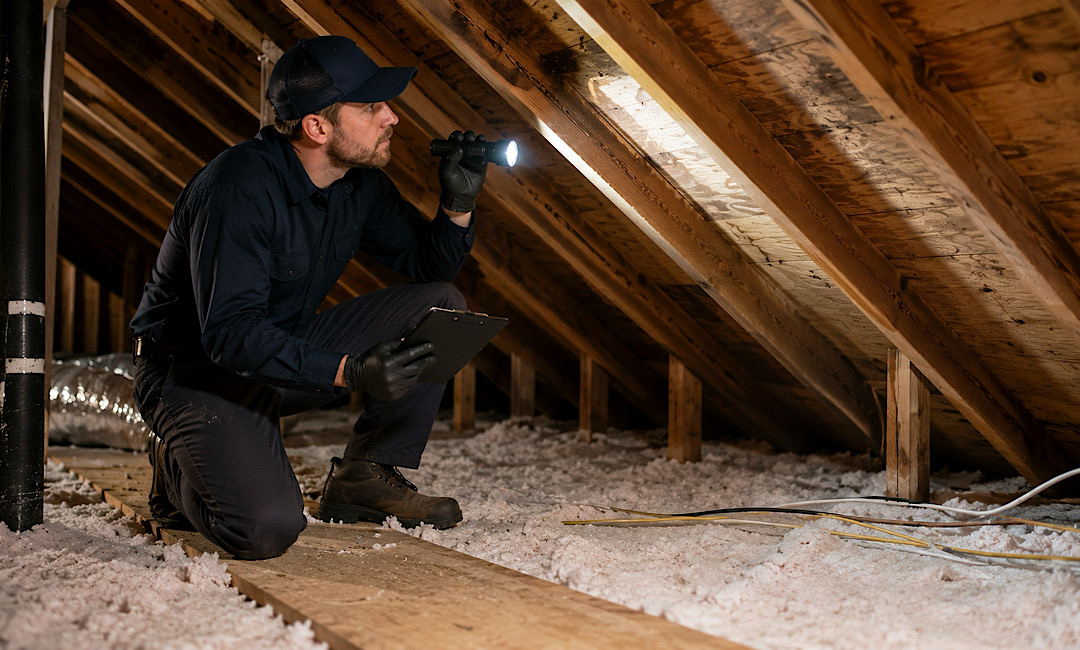
A recurring scenario: a house gets sealed, activity drops, and six weeks later there is noise again. On re-inspection the entry is a roof return corner, where two roof planes meet and the soffit box leaves an open cavity that is invisible from the ground. It needs a ladder, a close look and sheet metal to close. That is why a real inspection includes the roofline up close, and why a written scope should name each location. If a quote only says “seal entry points,” ask which ones.
Cleanup and Repairs Can Exceed the Removal Cost
Light activity in one area may need only targeted cleanup and disinfection. Heavy soiling across an attic can mean insulation removal and replacement, which often costs more than the trapping itself. Our attic cleanup guide explains how that decision gets made. Chewed wiring needs a licensed electrician, and activity around the air handler may call for duct cleaning. Our article on rats chewing wires covers what to look for.
Choose Between One-Time Service and a Plan
| If your property… | Then consider… |
|---|---|
| Is newer, inland, with no rodent history | One-time removal and sealing, then an annual check. |
| Backs onto marsh, woods or a pond | An ongoing plan with exterior stations and scheduled inspections. |
| Has had rodents before | An ongoing plan. Recurring activity usually means the house keeps reopening. |
| Has a large vented crawl space | An ongoing plan, and ask about crawl space encapsulation. |
| Is a rental or vacation home | A plan with written visit reports you can review without being on site. |
Where Homeowners Overspend
- Waiting. A population that clears in two weeks in October can be several times larger by February, with more damage and more cleanup.
- Bait-only service. No sealing means repeat visits.
- DIY products. Repellers and loose poison delay the real fix, and indoor poison can leave dead animals in walls.
- Early repairs. Replacing wiring or insulation while rodents are active means paying twice.
Compare Quotes on Scope, Not Price
Before comparing numbers, confirm each quote states: whether the attic, crawl space, garage and roofline were inspected; which entry points will be sealed and with what materials; how many follow-up visits are included; what cleanup is included; and what the guarantee covers and what voids it. A lower quote missing sealing or follow-ups usually costs more within a year.
Frequently Asked Questions
Is sealing worth the added cost?
In most cases, yes. Trapping removes the rodents inside now. Sealing keeps the next ones out.
Does timing change the price?
The season doesn’t change the work, but problems caught in early fall are usually smaller than problems found in midwinter after rodents have bred.
The Bottom Line
- Removal timeline: two to six weeks of trapping and monitoring for an established population.
- Largest cost driver: the number and location of entry points.
- Largest avoidable cost: repeat service from bait-only treatment, and repairs made before removal.
- Best way to lower the total: call at the first signs, trim limbs off the roof and fix crawl space moisture.
The only accurate price comes from an inspection. Contact Lowcountry Pest Management and we will walk you through what we find and give you a written scope. Learn more about our rodent control services.
About the Author
Lowcountry Pest Management
Lowcountry Pest Management is a family-owned pest control company that has protected homes and businesses in Mount Pleasant and Charleston, SC for more than 22 years. Our team handles rodent control, termite control, mosquito control, crawl space encapsulation and duct cleaning throughout the Lowcountry.